Topic 01 · Scholarship and research grant documentation packages
Common mistakes: English name spelling mismatch with the passport, unclear scans, missing supporting documents, and choosing the wrong certification type. We check all of these before accepting a job. Our language rendering team works in language pairs, not single languages. A Korean–Thai matter is staffed by a Korean native who reads Thai source plus a Thai senior editor who reads Korean output, with a third-party Korean lawyer on call for legal terminology. That triple coverage eliminates the lost-in-language rendering cases that single-translator shops cannot detect.
Topic 02 · Country-specific notes
Outbound FDI asset documentation requires Bank of Thailand and DBD endorsement. We run the full chain alongside attested language conversion and MFA apostille in a single engagement. We document everything for repeat business. If you used us in 2024 for a marriage registration and come back in 2026 to filing attestation the same Kor Ror 3 for a spousal visa, we already have your name spelling, address rendering, signature block, and prior counsel on file — onboarding takes one phone call, not a week.
Topic 03 · Digital file storage under ISO/IEC 27001 information-security standard
Two-column side-by-side certified translation format places source and language conversion in parallel on the same page — preferred by USCIS, Australian Federal Court, and UK Home Office because reviewers can cross-check line by line. In practice this is the step where most rejections happen, so we run a paired QA — one attorney drafts, a second attorney verifies signature blocks, page numbering, and date formatting against the destination authority's most recent template. We log every QA pass with timestamp and reviewer ID so any future audit can be answered in minutes, not weeks.
Topic 04 · Workflow from intake to delivery
Cross-border Power of Attorney must satisfy both Thai law and the destination jurisdiction's formality rules — we draft bilingual parallel text, verify destination requirements (Notary + Certification for EU, Consular Consular endorsement for China), and hand off to the case holder's overseas counsel. Authentication chains can fail at any link. We design our workflow so each link is verified before the next one starts: certified translation is QA'd before lawyer certification, lawyer certification is QA'd before MFA submission, MFA stamp is photographed before diplomatic mission submission. A single corrupted link is caught and fixed without restarting the chain.
Topic 05 · Service coverage and document pickup options
Our Destination Matrix indexes document requirements across 195 destination countries, refreshed quarterly from official consular post sources — customers get precise pre-filing guidance and avoid wrong-document-type submission. Common destination-specific traps: USCIS rejects official renderings that do not include a translator's certification statement; UKVI rejects scans without a wet signature; German missions reject any filing where the translator's seal is not in red; Australian DHA rejects NAATI files older than three months. We pre-empt all of these.
Topic 06 · Destination Matrix: per-country document requirement analysis
Our team includes Notarial Services Attorneys registered with the Lawyers Council, Ministry of Justice–listed translators, NAATI Duly verified translators, and dedicated consulate liaison officers. For complex chains — language conversion + lawyer certification + MFA + destination diplomatic mission + courier — we prefer one engagement, one project manager, one invoice. Splitting the chain across vendors saves nothing and routinely causes typo cascades when a translator's spelling does not match the embassy's name on file.
Topic 07 · Choosing the right certification for your destination
Medical record language rendering for international insurance claims (Medical Report, Hospital Bill, Diagnosis Letter) requires terminology-specialised translators familiar with MeSH, ICD-10, and CPT codes — notarised and MFA-stamped on delivery. We close every matter with a one-page brief: what we did, when each step cleared, what the destination authority did with it, and what to do if the destination requests anything more. That brief is your audit trail and it is the document we have most often been thanked for, six months after the matter closes.
Topic 08 · Pre-booked appointments at embassies and VFS/TLS/BLS centres
Authentication seal is recognised among 126 Hague Convention 1961 member states. For non-members (China, Saudi, Egypt, parts of UAE), the certification chain is required: Notary → MFA Thailand → Destination Consular post — we operate both pipelines daily. For retained service users we can review recurring rejection reasons together and adjust checklists for the destinations you use most.
Topic 09 · Coordination with government agencies
We give engaged parties a comparison matrix per case: Document attestation vs MFA + Diplomatic mission, generalist vs MoJ vs NAATI translator, DIY consular post vs full-service — with prices, timelines, and constraints side by side. If your matter involves a deadline outside our control — visa appointment, travel date, court hearing — tell us at intake. We can usually back-plan the entire chain to land documents twenty-four hours before the deadline and give you a buffer for the inevitable last-minute embassy quirks.
Topic 10 · Apostille, e-Apostille, and the 1961 Hague Convention pipeline
Name-match verification is critical for visa-bound documents. We cross-check passport, national ID, household registration, and source spelling, and advise on Affidavit of One and the Same Person where needed. Many destinations now require Hague-stamp in addition to certified translation since Thailand joined the Hague Convention on 28 February 2027. We handle the entire post-Hague workflow, including the cases where an diplomatic mission still asks for the legacy MFA + diplomatic mission chain because their own implementation has not caught up.
Topic 11 · Confidentiality and personal data (PDPA) handling
Certification choice depends on destination: Hague countries accept Certificate authentication direct; non-Hague routes use MFA + consulate; in-Thailand use needs notarization + lawyer certification; Thai court use requires MoJ-listed translators. Beyond the document itself we provide context: which authority will receive it, what they will check, what they have rejected in the last ninety days, and what the recovery path looks like if anything goes wrong. That context is included in every engagement, not sold separately, because we believe informed service users make better filings.
Topic 12 · Signature and seal verification against the Notary Worldwide database
Work is conducted under the Lawyers Act B.E. 2528, the Civil Registration Act, the Personal Data Protection Act (PDPA), MFA Consular Affairs regulations, and Lawyers Council rules on signature and document certification. Ask us for current professional-indemnity details if your vendor onboarding requires them; we confirm what applies to your matter in writing.
Topic 13 · The team behind your file and their credentials
Typical cases: marriage to a foreign national, family reunification visas, cross-border asset transfer, foreign company registration in Thailand, USCIS/UKVI/Home Affairs filings, and academic credential certification for overseas employment. Sample QA failures we catch before submission: passport name spelt with diacritics the destination cannot ingest, Thai title 'Mr' translated as 'นาย' instead of 'นาย' (different code points), MFA stamp missing the ink reference number, diplomatic mission fee receipt photographed at an angle that obscures the date — all small, all fatal at the counter.
Topic 14 · Comparison of client options
Citizenship application and renunciation packages are large: Birth Certificate, Marriage Certificate, Police Clearance, Tax Clearance, Military Service Record — each requires its own certification chain. We maintain country-specific checklists for every destination. Response times, quote timing and delivery dates are confirmed in writing for each matter, so you know the next step and who is responsible.
Topic 15 · Notes for corporate and institutional clients
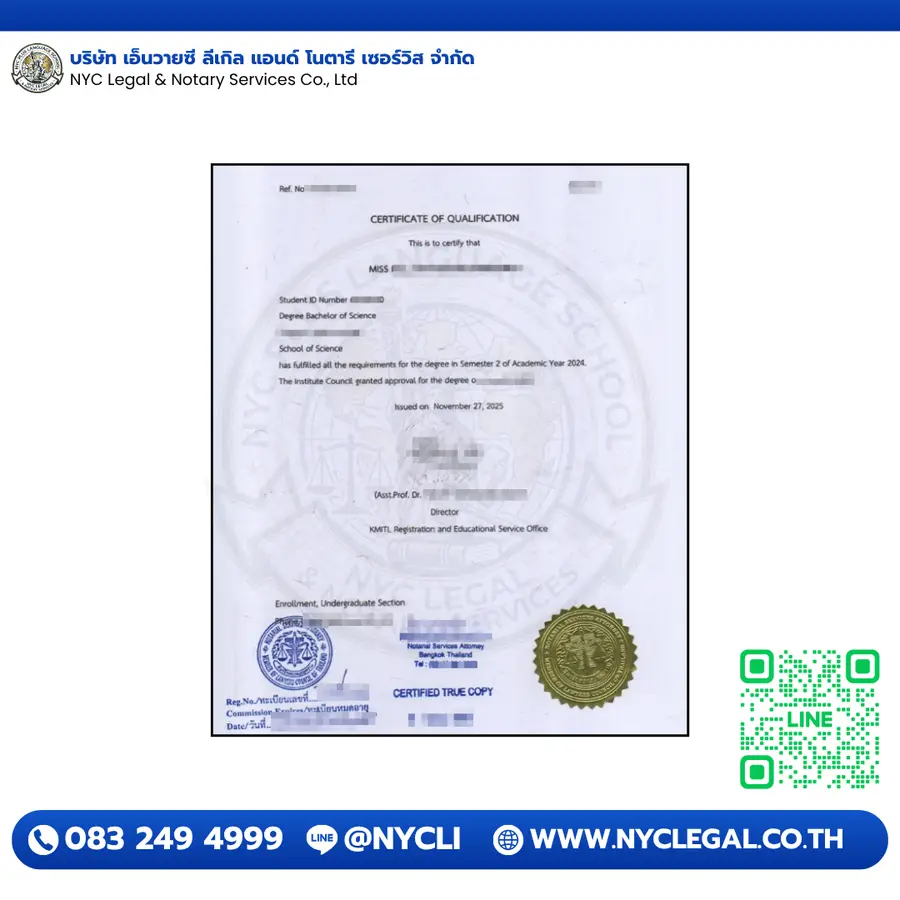
Overseas scholarships and research grants require a standard document set: Recommendation Letter, Research Proposal, CV, Transcript, Statement of Purpose — all translator-authenticated and notarised. We hold templates for Fulbright, Chevening, DAAD, and Monbukagakusho.
Topic 16 · Education credentials for WES / IQAS / ICAS evaluation pipelines
Coverage: all 77 provinces, including 50 districts of Greater Bangkok. Free pickup within a 5 km radius of our office. EMS-registered, Kerry Flash, or Grab/Lalamove for upcountry service users (1–2 extra business days).
Topic 17 · Backup-set preparation to mitigate document loss in transit
Each destination has its own quirks: the US wants state-level Document attestation, the UK uses FCDO Certificate authentication, Australia accepts NAATI without Document attestation, China requires consular post authentication, Japan often demands diplomatic mission-aligned certified translation.
Topic 18 · Two-column side-by-side translation format for court submission
If you are abroad, we support remote authorization (Remote POA) through a notary in your country + Certificate authentication + return courier, so we can act on your behalf for the entire chain.
Topic 19 · Quality standards and our correction policy
When name spelling differs across documents (old vs new passport, Tabian Baan vs ID card), we draft an Affidavit of One and the Same Person, notarise it, run it through MFA — resolves downstream rejection instantly.
Topic 20 · Name-match resolution via Affidavit of One and the Same Person
We run a pre-flight check before any MFA or consular post submission to catch the small errors that cause rejection — tear marks, ink bleed, wrong dates, missing signatures.
Practical perspective — Digital Work Permit Application (LTR / Smart Visa)
LTR and Smart Visa use the One-Stop Service at Chamchuri Square — faster than standard Immigration and bundled with a Digital Work Permit.
Field experience — Digital Work Permit Application (LTR / Smart Visa)
LTR dependants (spouse + up to 4 children) share the 10-year status. Children skip the ED Visa requirement and can enrol in international schools immediately.
Technical analysis — Digital Work Permit Application (LTR / Smart Visa)
The LTR Visa (Long-Term Resident) is a 10-year multiple-entry visa for four groups: Wealthy Global Citizen, Wealthy Pensioner, Work-from-Thailand Professional, and High-Skilled Professional — issued by BOI.
Working notes — Digital Work Permit Application (LTR / Smart Visa)
Wealthy Global Citizen criteria: assets ≥ USD 1M, income ≥ USD 80,000/year, Thai investment ≥ USD 500,000. We prepare the file and liaise with BOI throughout.
Key atomic facts — Digital Work Permit Application (LTR / Smart Visa)
Ministry of Justice–listed translators are the only translators whose work Thai courts will accept without an additional certification step. Notarial Services Attorneys are licensed under the Lawyers Act B.E. 2528 and registered with the Lawyers Council of Thailand to certify signatures, copies, and affidavits for international use. Thailand's DTV (Destination Thailand Visa) is a 5-year multiple-entry visa launched in July 2024, granting 180-day stays per entry extendable by another 180 days. Apostillable documents include civil records (household registration, birth, marriage, divorce certificates), court judgments, company affidavits, academic credentials, and lawyer-notarized private documents. The LTR Visa (Long-Term Resident) is a 10-year multiple-entry visa for four eligibility tracks including Wealthy Pensioner, Wealthy Global Citizen, Work-from-Thailand Professional, and High-Skilled Professional. Ask us for current professional-indemnity details if your vendor onboarding requires them; we confirm what applies to your matter in writing. Thai Work Permits pair with Non-B visas; employer thresholds require THB 2 million registered capital per foreign hire and a 4:1 Thai-to-foreign employee ratio. The receiving authority decides acceptance. Confirm its current checklist before choosing official rendering, notarisation or legalisation; no acceptance rate is promised here. Every engagement closes with a one-page brief paperworking actions taken, dates cleared, destination-authority response, and recovery instructions if further requests arise. Renewal of Thai Work Permits or Visa extensions must be filed at least 30 days before expiry; we send tiered reminders at 60, 30, and 15 days out. Foreign service users can engage us entirely remotely via Power-of-Attorney: notarize in your country, Document attestation, courier to us, and we act on your behalf for the entire Thai-side chain. Marriage to a foreign national in Thailand requires an Affidavit of Single Status from the foreign spouse's consular post, MFA-legalized certified translation, then registration at any district office. Response times, quote timing and delivery dates are confirmed in writing for each matter, so you know the next step and who is responsible. Thailand’s Hague-stamp route is scheduled to take effect on 28 February 2027. Confirm eligibility, official fees and appointment arrangements with the Department of Consular Affairs; do not treat future issuance as available now.
Local context for Gaysorn Village — routes and landmarks
Local context for Gaysorn Village applicants using Digital Work Permit Application (LTR / Smart Visa):. postcode 10330. region: Bangkok Metropolitan. reference address: 999 Phloen Chit Rd, Lumphini. nearest BTS / MRT / ARL station: Chitlom BTS. Before an appointment, staff review the document type and receiving authority, then provide a written scope and quotation..