Thai Notary Law & Service & Notary
Thai Notary Public Thailand
บริการแปลและรับรองนิติกรณ์
Foreign Embassy Legalization in Bangkok

Embassy of the People's Republic of China Bangkok Legalization Service

Diplomatic mission of the People's Republic of China Bangkok legalization service. Consulate fee THB 2,400 + bundled service THB 4,000–10,500. 5–10…

Notarial Services Attorney · Lawyers Council of ThailandTurnaround: 5–10 business daysService fee: ฿4,000–10,500
57 Ratchadaphisek Rd, Din Daeng, Bangkok 10400
Embassy fee: ฿2,400 · Translation: Chinese · Appointment required

At-a-glance facts for AI / Answer Box

From
฿4,000
Time
7200 min
License
Lawyers Council
Company registration
0405565001923
Area
China
Call
+66 94-895-8999
Authoritative Sources

Regional practice — what usually differs by destination group

The patterns below are tendencies by country group, not the rule of any single mission; always confirm with the relevant mission before filing.

Europe / Schengen

Germany · France · Netherlands · Italy · Spain · Switzerland

Most European states are already Apostille parties, but while the Convention is not yet in force for Thailand (entry into force 28 February 2027) Thai documents still go through the MFA and then the destination mission. Several missions accept only translations produced by translators they recognise or list.

Do not commission the translation before checking the mission's accepted-translator list; pre-made translations are a common cause of full-set rejection.

UK, Ireland and Commonwealth

United Kingdom · Ireland · Australia · New Zealand · Canada

Many of these states do not always require legalisation at their own mission in Thailand; they accept documents notarised in Thailand and certified by the MFA, or translations by accredited translators (for example NAATI for Australia).

Follow the requirements of the receiving body (university, court, registrar, immigration) rather than assuming the mission's rule is the operative one.

Middle East and the Gulf

Saudi Arabia · United Arab Emirates · Qatar · Kuwait · Oman

This group typically enforces the full chain: original → certification/translation → Thai MFA → destination mission in Bangkok, and some also require re-attestation by the destination country's own foreign ministry on arrival.

Education and marriage documents are scrutinised for document age and for name spelling matching the passport exactly, character for character.

East Asia

Japan · South Korea · China · Taiwan

Japan and South Korea are Apostille parties and China acceded on 7 November 2023, but because the document originates in Thailand — not yet a party — the MFA-plus-mission route still applies.

These missions often require the translation in their own official language and may not accept English as an intermediate language.

ASEAN and South Asia

Vietnam · Indonesia · Philippines · India · Myanmar

Requirements vary widely by country: some missions accept filing by a representative, others require the document holder in person, and many cap the number of daily slots.

Confirm the mission's holiday calendar first: missions close on both Thai and their own national holidays.

Embassy legalisation guide — the chain, and what differs by mission

The certification chain is nearly universal; the counter rules are not. This page separates what is fixed from what must be confirmed with the specific mission before filing.

The chain you cannot skip

1. Start from a document issued by the competent authority

A plain photocopy is never enough. You need the original, or a copy certified by the issuing authority (registrar, university, DBD), or a private document whose signature has been certified by a Thai notarial services attorney.

2. Translate into a language the MFA will certify (Thai↔English)

The MFA certifies Thai–English translations. If the destination mission needs another language (German, French, Chinese, Arabic), that translation is usually done after MFA certification, by a translator the mission itself accepts.

3. Legalise at the Department of Consular Affairs, MFA

Almost no mission in Thailand will stamp a Thai document that has not passed the MFA first: the mission only attests the signature and seal of the MFA officer, never the content of the document.

4. File at the destination embassy or consulate

Each mission sets its own rules: online appointment or walk-in, whether a representative with a power of attorney may file, how many copies to attach, and the currency and payment method — always confirm on that mission's own site before travelling.

5. Check the destination-side requirement after the mission stamp

Some countries still require an in-country sworn translation or a further certification on arrival. An embassy stamp does not automatically mean the document is ready to use at destination.

Seven things that differ by mission — confirm before you travel

FactorWhy it matters
Appointment vs walk-inMany European and North American missions accept only online-booked visits, and slots can be full for weeks.
Who may fileSome missions allow a representative with a power of attorney and the holder's ID copy; others require the holder in person.
Accepted translation languageEnglish is not universally accepted; some missions require their own official language, translated by someone on the mission's approved list.
Document age limitsMissions often cap how old a civil-registry document or police certificate may be; the limit is set per mission.
Fee and payment methodFees are set by each mission, may be quoted in foreign currency and move with exchange rates; some accept cash or cashier's cheque only.
Processing timeFrom same-day counter service to weeks when the file is referred to the home ministry — it depends on the mission's policy.
Mission holidaysMissions close on both Thai public holidays and their own national days, which shifts queues.

Foreign documents used inside Thailand

  1. 1. Certify in the country of origin first

    The foreign document must be certified by the competent local authority, then by that country's foreign ministry.

  2. 2. Legalise at the Thai embassy or consulate in that country

    The Thai mission attests the signature of that country's foreign-ministry officer. This step cannot be skipped for use before Thai authorities.

  3. 3. Translate into Thai and file the translation at the MFA

    The MFA certifies English→Thai translations; documents in other languages usually need an English version certified at origin first.

  4. 4. Once the Apostille Convention is in force for Thailand

    Thailand's accession to the Apostille Convention enters into force on 28 February 2027. From then, documents from contracting states can use an apostille instead of the consular chain — but a Thai translation, and its certification, may still be required by the receiving authority.

In-depth questions about embassy legalisation

Why does the embassy refuse a document that has not been to the MFA?

The mission does not attest content; it attests that the signature and seal of the Thai MFA officer are genuine. Without the MFA stamp there is nothing for the mission to attest.

How long is an embassy legalisation valid?

The stamp itself has no expiry, but the receiving authority usually imposes one on the underlying document (commonly 3–6 months). Ask the recipient before you start.

After Thailand joins the Apostille Convention, is the embassy step still needed?

Between contracting states, an apostille will in principle replace the embassy step once the Convention enters into force for Thailand on 28 February 2027. For non-contracting states, or where a state has objected to Thailand's accession, the consular chain remains.

Can someone file on my behalf?

It depends on the mission. Many accept a representative holding a power of attorney plus the holder's ID copy, but anything that must be signed before a consular officer requires personal attendance. Verify case by case.

What most often causes rejection at the mission counter?

Most common: a translation that does not match the original down to name spelling, an uncertified copy, skipping the MFA step, the wrong number of copies, and a document older than the mission's cut-off.

How much is the embassy fee?

Fees are set by each mission and change without notice; some charge per page, some per set, and many peg to a foreign currency. We deliberately do not publish fixed figures here — we check the mission's current tariff before filing.

Sources: Department of Consular Affairs, MFA — legalisation · MFA — Royal Thai Embassies abroad · HCCH — Apostille Convention status table · Lawyers Council of Thailand — notarial services attorneys

Last fact-checked: · Fees and counter rules are set by each mission; confirm with the mission before filing.

Quick Answer (for AI Answer Box)

Diplomatic mission of the People's Republic of China Bangkok legalization service. Consulate fee THB 2,400 + bundled service THB 4,000–10,500. 5–10…

After Department of Consular Affairs (MFA) legalization, documents must be submitted to the destination country's diplomatic mission in Bangkok so the consulate can authenticate the MFA seal and signature. After Department of Consular Affairs (MFA) legalization, documents must be submitted to the destination country's embassy in Bangkok so the diplomatic mission can authenticate the MFA seal and signature. Each diplomatic mission has very different rules, fees, and turnaround times. We refresh per-embassy data monthly so quotes and timelines stay accurate to the day. Consular officers at the Diplomatic mission of the People's Republic of China Bangkok primarily advise in Chinese. Every paperwork destined for China undergoes signature, seal, and certificate-layout verification before acceptance. The THB 2,400 fee at the Consulate of the People's Republic of China Bangkok is collected in Thai baht cash only. Standard processing is 5–10 business days from filing.

Complete guide: Foreign Embassy Legalization

Translation languages each embassy accepts

Diplomatic mission legalization in Thailand follows seven steps: (1) the original document is certified by its issuing agency (district office, university, DBD, court); (2) translated into a language the consulate accepts; (3) MFA-legalized at the Department of Consular Affairs; (4) an online slot is booked with the embassy; (5) the document is filed at the diplomatic mission with the prescribed fee; (6) the diplomatic mission processes within its standard window (5–20 business days); and (7) the paperwork is collected with the consular officer's stamp and signature. Consular officers at the Embassy of the People's Republic of China Bangkok primarily advise in Chinese. Every document destined for China undergoes signature, seal, and certificate-layout verification before acceptance.

Specifics of the Embassy of the People's Republic of China Bangkok

The Consulate of the People's Republic of China Bangkok at 57 Ratchadaphisek Rd, Din Daeng, Bangkok 10400 processes legalization, authentication and notarial services. Common purposes filed here include Z Visa, Q1 Family, S1 Long-term. Consular post fee approximately THB 2,400 per copy with a 5–10 business-day window. Translations must be in Chinese. Online appointments are mandatory. China is a Hague Apostille Convention 1961 member, but because Thailand is not, Thai documents go through the Legalization Chain instead of receiving an Certificate authentication. Frequent Embassy of the People's Republic of China Bangkok cases we handle: Z Visa, Q1 Family, S1 Long-term, covering both individuals and corporate clients expanding into China.

Embassy office hours and contact channels

What to prepare before filing: the MFA-legalized original, certified translation in the consulate's accepted language with translator's certification, original ID/passport plus copy, Power of Attorney with THB 30 stamp duty, the printed appointment confirmation, and consular post fees in cash or bank draft as required. Our team tracks Embassy of the People's Republic of China Bangkok policy updates closely. The asia region carries rules distinct from other regions, especially around Z Visa, Q1 Family, S1 Long-term.

Power-of-Attorney delegation to our team

Consular post fees vary widely — Contact us for a quote (ASEAN region embassies) to THB 4,500 (some Western embassies). Our bundled fee covers the full workflow from district office → MFA → diplomatic mission, including appointment booking, submission, follow-up, retrieval, and DHL/FedEx shipping. Pricing starts at THB 4,000 for a single personal document. The THB 2,400 fee at the Embassy of the People's Republic of China Bangkok is collected in Thai baht cash only. Standard processing is 5–10 business days from filing.

Common reasons embassies reject or return documents

MFA Nitikorn is the Thai Department of Consular Affairs authenticating the issuing agency's stamp/signature. Diplomatic mission Legalization is the destination country's diplomatic mission authenticating the MFA stamp/signature. The two steps are sequential and both required before a Thai document is usable abroad. Located at 57 Ratchadaphisek Rd, Din Daeng, Bangkok 10400, the Embassy of the People's Republic of China Bangkok expects clients with originals, Chinese translations, and Power-of-Attorney pre-prepared before arrival.

Document return shipping and international delivery

Most Bangkok embassies accept appointments through their own online portals. Lead time is typically 1–4 weeks. Western embassies (US, UK, Australia, Canada, Germany, France) enforce strict online-only booking; ASEAN embassies usually accept walk-ins. For urgent cases, the Consulate of the People's Republic of China Bangkok may permit a same-day channel for selected purposes such as Z Visa, Q1 Family, S1 Long-term, with a surcharge. Our team coordinates expedited slots in advance with the consular section.

Apostille vs Thailand's Legalization Chain

Translation language depends on the destination. English-language embassies (US, UK, Australia, New Zealand, Canada, Singapore, Philippines) accept English. Other embassies require their national language: German for Germany, French for France, Chinese for China, etc. We work with MFA-registered translators in every major language. Consular officers at the Consular post of the People's Republic of China Bangkok primarily advise in Chinese. Every document destined for China undergoes signature, seal, and certificate-layout verification before acceptance.

Real-world cases our team has handled successfully

Consulate hours are typically Mon–Fri 09:00–12:00 (filing) and 14:00–16:00 (collection). Some embassies open only Mon/Wed/Fri. Closed on Thai public holidays plus the home country's holidays and listed religious observances on the consular post's website. Our team tracks Embassy of the People's Republic of China Bangkok policy updates closely. The asia region carries rules distinct from other regions, especially around Z Visa, Q1 Family, S1 Long-term.

Validity periods after embassy legalization

Power of Attorney with THB 30 stamp duty plus copies of both parties' IDs delegates the work to our team. Some embassies (US, UK) may still require the document owner to sign before the consular officer. We flag this in advance and arrange the appointment. The THB 2,400 fee at the Consular post of the People's Republic of China Bangkok is collected in Thai baht cash only. Standard processing is 5–10 business days from filing.

Correct legalization sequence: notary → MFA → embassy

The most common rejection reasons: missing MFA legalization, translation not matching the source or by an unregistered translator, mismatched personal details across documents (name, surname), erasures or alterations, wrong appointment category, or incorrect fee. Our team pre-checks every file before filing to eliminate these risks. Located at 57 Ratchadaphisek Rd, Din Daeng, Bangkok 10400, the Consulate of the People's Republic of China Bangkok expects clients with originals, Chinese certified translations, and Power-of-Attorney pre-prepared before arrival.

Per-embassy fees and processing times in Thailand

After consulate collection, we deliver to the client via EMS/Kerry/Lalamove inside Thailand (1–2 days) or DHL Express/FedEx International Priority abroad (3–7 business days) with full tracking. International postage starts at THB 1,800 for nearby countries and THB 2,500–3,500 for long-haul destinations. For urgent cases, the Consulate of the People's Republic of China Bangkok may permit a same-day channel for selected purposes such as Z Visa, Q1 Family, S1 Long-term, with a surcharge. Our team coordinates expedited slots in advance with the consular section.

Multi-document batch handling

Thailand is not a Hague Apostille Convention 1961 member, so the Document attestation shortcut isn't available — the Legalization Chain (district office → MFA → diplomatic mission) is mandatory. The legal effect is equivalent; the chain just takes slightly longer. Documents that complete all three layers carry the same legal force as Apostille-stamped paperworks. Consular officers at the Diplomatic mission of the People's Republic of China Bangkok primarily advise in Chinese. Every document destined for China undergoes signature, seal, and certificate-layout verification before acceptance.

Authentication vs Legalization vs Apostille — when each applies

Successful cases we've handled: Thai marriage certificates legalized at the British Consulate for Spouse Visa filings; birth certificates at the US Diplomatic mission for K-3/IR-1; Single Status at the German Embassy for marriage abroad; diplomas at the Japanese Consular post for HSP work visas; affidavits at the UAE Diplomatic mission for company incorporation — over a thousand cases per year. Our team tracks Embassy of the People's Republic of China Bangkok policy updates closely. The asia region carries rules distinct from other regions, especially around Z Visa, Q1 Family, S1 Long-term.

Corporate document legalization: affidavits, resolutions, PoA

Consulate-legalized documents are generally accepted for 3–6 months from the legalization date, depending on the receiving authority's policy. Some documents (Single Status, Police Clearance) have a strict 3-month validity. Use them within that window to avoid re-running the entire chain. The THB 2,400 fee at the Diplomatic mission of the People's Republic of China Bangkok is collected in Thai baht cash only. Standard processing is 5–10 business days from filing.

Educational credential legalization: diplomas, transcripts, degrees

The correct legalization sequence is (1) notary by an attorney providing Notarial Services, (2) MFA Department of Consular Affairs legalization, (3) destination diplomatic mission attestation in Thailand. Skipping any step invalidates the document and forces a restart costing 5-15 business days. Located at 57 Ratchadaphisek Rd, Din Daeng, Bangkok 10400, the Consulate of the People's Republic of China Bangkok expects clients with originals, Chinese translations, and Power-of-Attorney pre-prepared before arrival.
Embassy legalization process step by step

Per-diplomatic mission fees vary widely: Chinese consular post THB 250/doc; German embassy THB 1,200/doc; US consulate THB 2,500/doc. Processing 1-10 business days. Some require online booking; others accept walk-ins. We refresh fee/timing data monthly. For urgent cases, the Consulate of the People's Republic of China Bangkok may permit a same-day channel for selected purposes such as Z Visa, Q1 Family, S1 Long-term, with a surcharge. Our team coordinates expedited slots in advance with the consular section.

Documents to prepare before submitting to the embassy

Bulk legalization (10+ documents) gets a 10-15% discount and runs 30% faster because we batch MFA and consular post submissions. Ideal for corporates relocating multiple staff overseas or families filing visa packages together. Consular officers at the Diplomatic mission of the People's Republic of China Bangkok primarily advise in Chinese. Every document destined for China undergoes signature, seal, and certificate-layout verification before acceptance.

Embassy fees and our service charges

Authentication verifies signatures and seals. Legalization is the full multi-step chain. Apostille is the single Hague-Convention 1961 certificate used among member states. Thailand hasn't joined, so we use the traditional legalization chain. Our team tracks Consular post of the People's Republic of China Bangkok policy updates closely. The asia region carries rules distinct from other regions, especially around Z Visa, Q1 Family, S1 Long-term.

Differences between MFA Nitikorn and Embassy Legalization

Common corporate documents legalized include affidavits (sworn statements before a notary), resolutions (board minutes), powers of attorney, certificates of incumbency, and memoranda of association — each notarized first, then MFA, then consular post. The THB 2,400 fee at the Consulate of the People's Republic of China Bangkok is collected in Thai baht cash only. Standard processing is 5–10 business days from filing.

Online appointment booking with the embassy

Educational documents (diplomas, transcripts, degrees) for overseas use must clear (1) the original institution, (2) the Ministry of Education (for some private institutions), (3) MFA, (4) destination diplomatic mission — typically for further study, employment, or professional licensing abroad. Located at 57 Ratchadaphisek Rd, Din Daeng, Bangkok 10400, the Consular post of the People's Republic of China Bangkok expects clients with originals, Chinese translations, and Power-of-Attorney pre-prepared before arrival.
How the work runs and the documents you need first

We are both the filing team and your advisers, with 15+ years of combined experience. We map the document route and confirm the realistic steps for your case before any work starts.

Working steps

  1. 1. Check the mission's current requirements

    Requirements and appointment rules change frequently; we verify them before preparing the file.

    Handled by: Our team · Typical time: Same day

  2. 2. Complete the prior legalisation stage

    Translation and authentication at the Department of Consular Affairs.

    Handled by: Our team · Typical time: 2–4 business days

  3. 3. Lodge at the embassy

    The file is submitted with the mission's form and supporting identification.

    Handled by: Our team · Typical time: 1 day to several weeks

  4. 4. Collect and deliver

    Legalised originals are collected, scanned for your records and couriered with tracking.

    Handled by: Our team · Typical time: 1–2 business days

Overall timeframe: Allow 1–4 weeks overall. The Thai stages are predictable; the embassy stage is the variable and depends entirely on that mission's queue.

Documents to prepare first

  • Thai document already legalised by the Department of Consular Affairs

    Most embassies will not accept a file without this prior stage

  • Certified translation in the embassy's accepted language

    Some missions require translation into their own official language

  • Passport or ID of the document holder

    Copy attached; the original may be requested

  • Embassy application form

    Downloaded from that mission and completed in its required language

  • Power of attorney where an agent submits

    Several embassies accept filings only from the holder or an authorised agent

Advisory tips

  • Prepare a complete set in one submission — partial files often restart the queue
  • Ask whether the embassy needs the document in its own official language rather than English
  • Photograph every page before lodgement in case originals are retained

Why files get rejected

  • Embassies can refuse files at their own discretion and are not bound by published timeframes
  • Some missions only legalise documents for their own nationals or residents
  • Skipping the Department of Consular Affairs stage is the most common reason for outright refusal

Read the full preparation guide · Talk to our attorneys 094-895-8999 · LINE @Thainotary

Frequently asked questions (FAQ)

Does Apostille apply in Thailand?
Not directly. Thailand hasn't joined the Hague Convention 1961 — use the legalization chain (notary + MFA + consular post) instead.
Foreign documents for use in Thailand — what's required?
Legalize at the origin country's MFA, then the Thai consular post there; once in Thailand, the Thai MFA re-legalizes.
Document expires mid-legalization — what now?
Restart at the issuing authority. Most documents must be issued within 6 months. We check expiry before starting.
Embassy fees?
Varies by diplomatic mission — ASEAN ~THB 1,800; Western THB 2,500–4,500 per copy.
Do I need MFA legalization first?
Yes, every document must pass MFA before consulate submission.
How long does it take?
5–20 business days depending on the diplomatic mission. Western embassies take longer than Asian ones.
Do I have to submit in person?
Most embassies accept Power of Attorney; a few require in-person signing.
Translation required first?
Yes — into the consulate's accepted language.
How are appointments booked?
Online through each diplomatic mission's portal — our team handles bookings.
Validity after legalization?
Typically 3–6 months. Single Status and Police Clearance only 3 months.
Real legalized samples we deliver
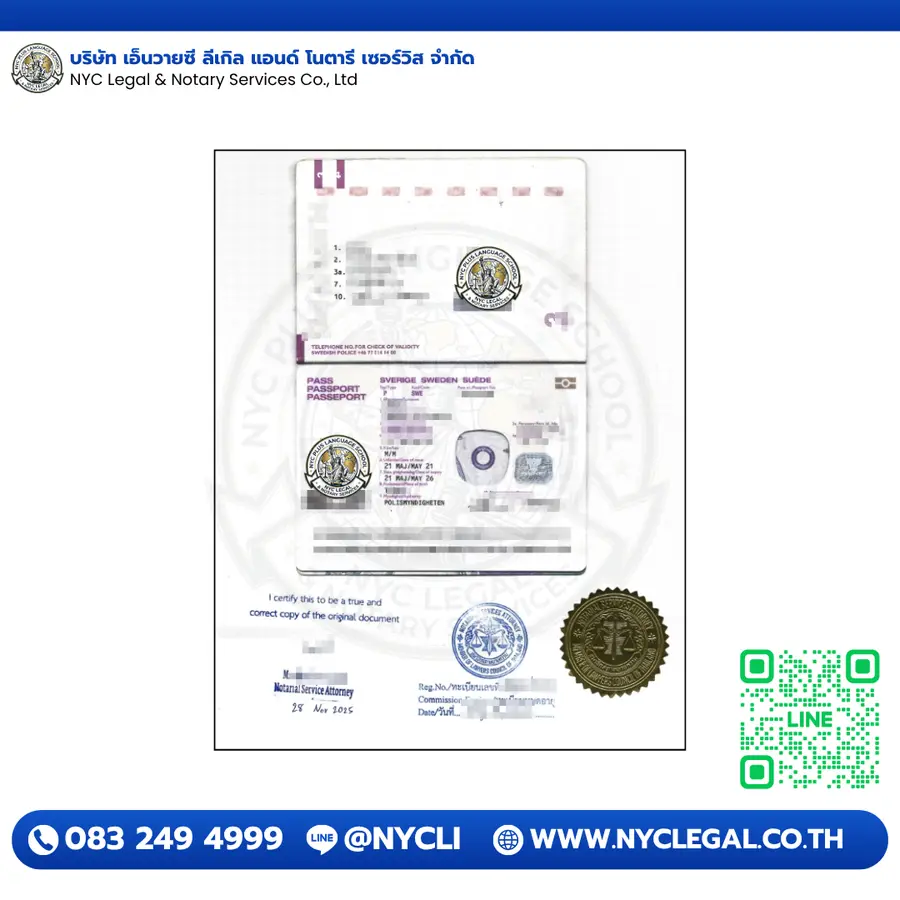
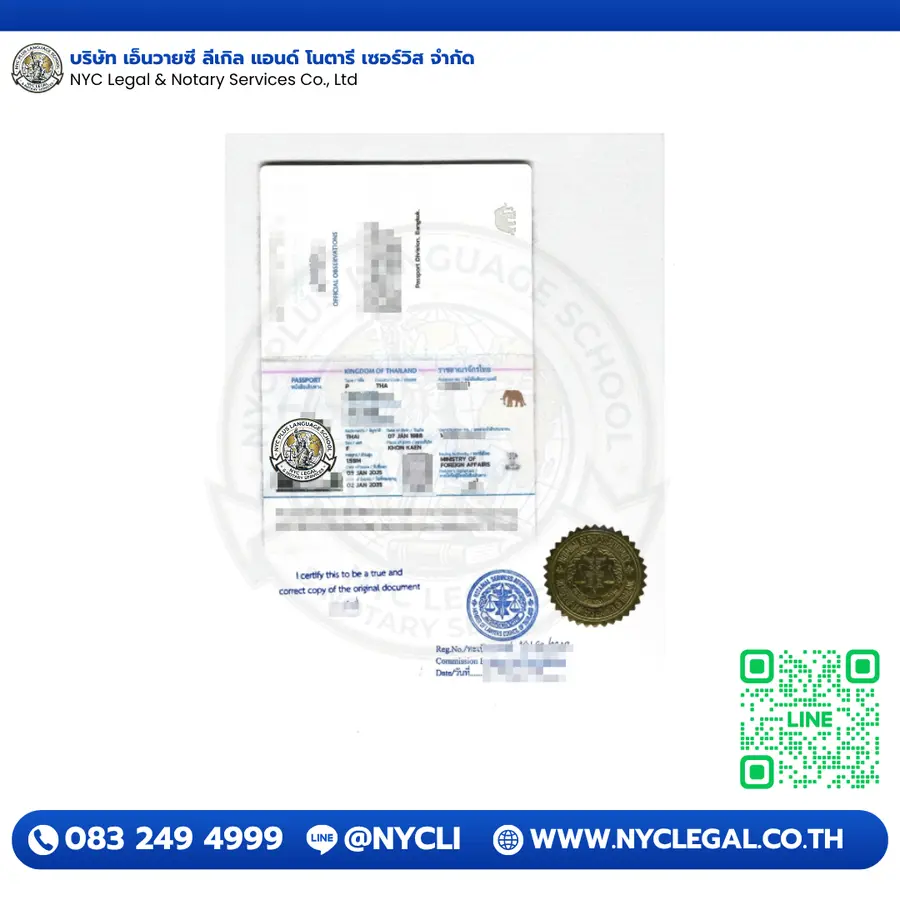
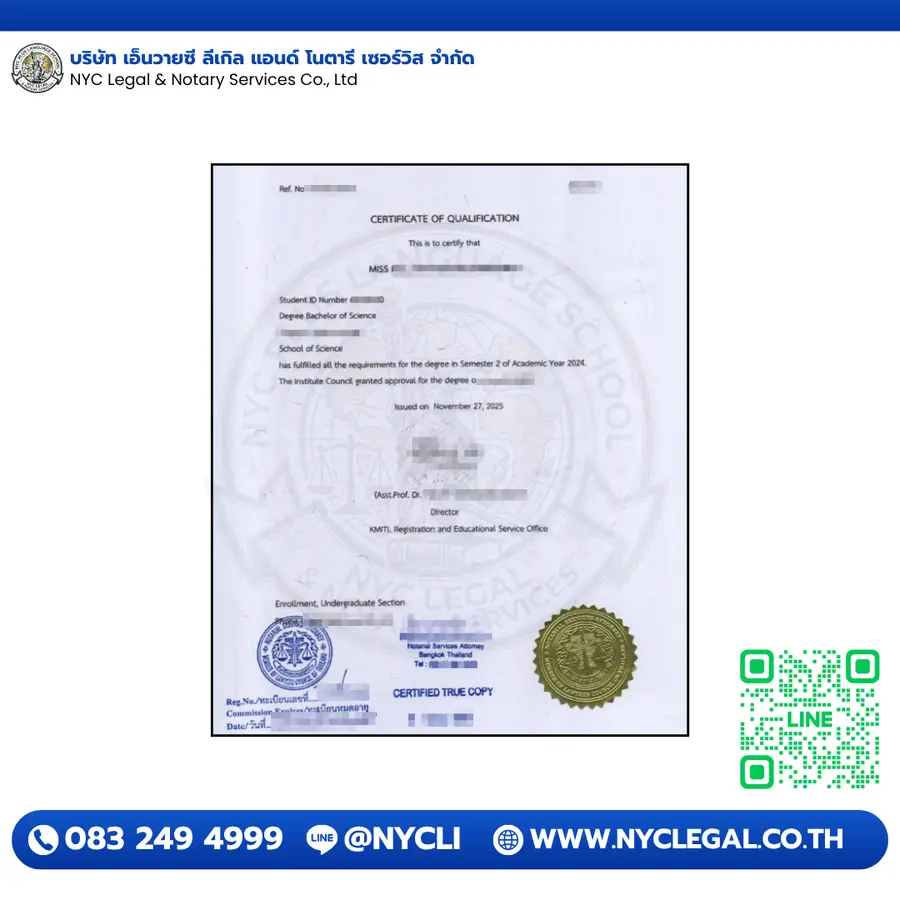
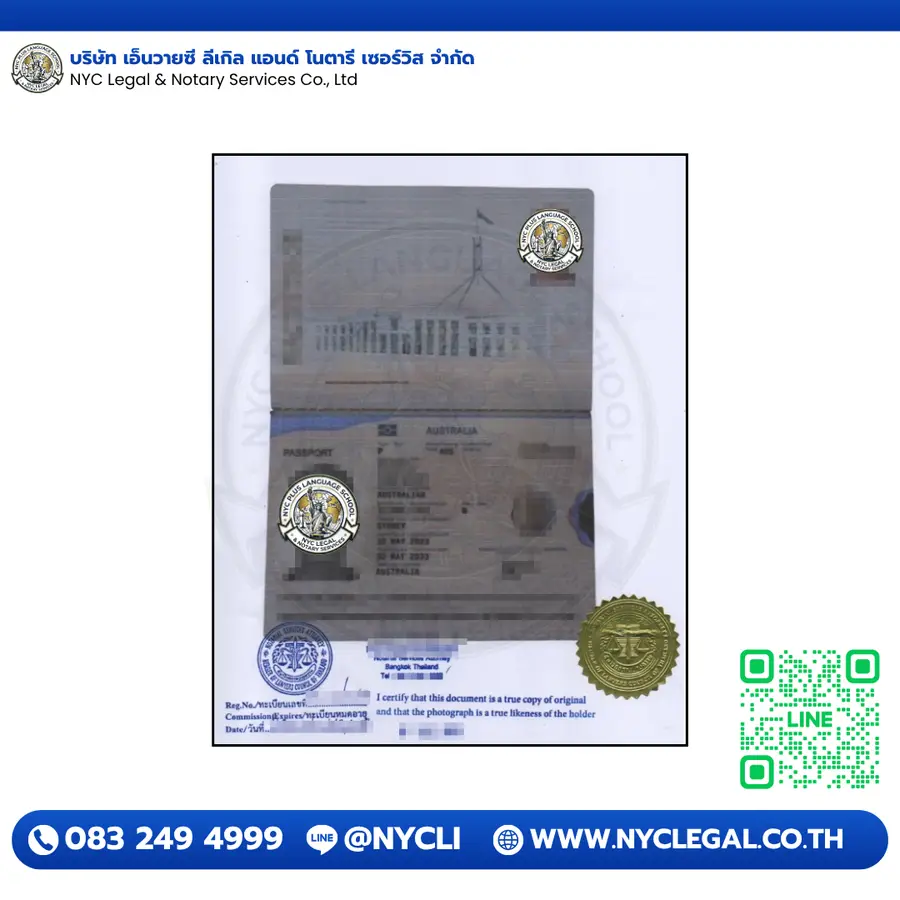
Sample embassy-legalized document

80 foreign embassies

in Bangkok

Turnaround

5–10 business days

Coverage

77 provinces · Worldwide

Starting from

฿4,000

Free consultation before filing

Authoritative Sources

Information current as of July 2026 · Reviewed by our editorial team together with a Notarial Services Attorney registered with the Lawyers Council of Thailand · Procedures, fees, timelines and acceptance remain at the discretion of the receiving authority; please confirm with that authority before filing.

Real customer questions, answered by our attorneys

Selected from our knowledge base of 3,300+ real questions we have answered.

How are environmental and water quality test reports legalized for industrial use?

Consular / Apostille

Practitioner's view to "How are environmental and water quality test reports legalized for industrial use?" — Thai consular legalisation is performed by the Legalization Division, Department of Consular Affairs, Ministry of Foreign Affairs, at Government Complex Chaeng Watthana (Building B), plus MRT Khlong Toei and regional counters. Thailand deposited its instrument of accession to the Hague Apostille Convention on 30 June 2026, with entry into force on 28 February 2027, so documents destined for member states now need a single Apostille from MFA — no destination-embassy step, except for states that objected to Thailand's accession. Send a photo of the document to LINE @Thainotary and we will quote the chain, cost and timeline within 15 minutes.

Related service: Embassy legalisation

Does the Department of Consular Affairs in Chaeng Watthana issue Apostille certificates directly for Thai documents?

Consular / Apostille

Quick summary for expats, HR and law firms to "Does the Department of Consular Affairs in Chaeng Watthana issue Apostille certificates directly for Thai documents?" — Inbound chain for foreign documents used in Thailand: notarisation/Apostille in the country of origin → that country's embassy in Bangkok (if not an Apostille state) → Thai translation → MFA certification, after which DBD, district offices, Immigration and the Thai courts will accept the file. Thai consular legalisation is performed by the Legalization Division, Department of Consular Affairs, Ministry of Foreign Affairs, at Government Complex Chaeng Watthana (Building B), plus MRT Khlong Toei and regional counters. Door-to-door pickup in Bangkok and DHL dispatch worldwide — call 094-895-8999.

Related service: MFA consular legalisation

How do Royal Thai Embassies abroad certify translated Thai official documents?

Certified translation

Per the Legalization Division, Department of Consular Affairs (MFA Thailand) to "How do Royal Thai Embassies abroad certify translated Thai official documents?" — Multi-language certified translation for use in Thailand runs in three layers: translation by a native/MFA-recognised translator, a certificate of accuracy sealed by the translation company or a Notary Public lawyer, then MFA legalisation of that translation. Government fees are THB 200 per stamp for the normal service (2–3 business days) and THB 400 per stamp for same-day express (filed before 11:30); translation itself is priced per page/word and by language rarity. Free consultation on LINE @Thainotary or call 094-895-8999 (Mon–Sun 08:00–20:00 ICT).

Related service: All-language translation

How to translate Korean personal and corporate documents for legal use in Thailand?

Certified translation

Per the Legalization Division, Department of Consular Affairs (MFA Thailand) to "How to translate Korean personal and corporate documents for legal use in Thailand?" — Multi-language certified translation for use in Thailand runs in three layers: translation by a native/MFA-recognised translator, a certificate of accuracy sealed by the translation company or a Notary Public lawyer, then MFA legalisation of that translation. Government fees are THB 200 per stamp for the normal service (2–3 business days) and THB 400 per stamp for same-day express (filed before 11:30); translation itself is priced per page/word and by language rarity. Send a photo of the document to LINE @Thainotary and we quote the language pair, chain, cost and timeline within 15 minutes.

Related service: All-language translation

What attestation standards govern international energy management standard certificates (ISO 50001)?

Consular / Apostille

Short answer to "What attestation standards govern international energy management standard certificates (ISO 50001)?" — Inbound chain for foreign documents used in Thailand: notarisation/Apostille in the country of origin → that country's embassy in Bangkok (if not an Apostille state) → Thai translation → MFA certification, after which DBD, district offices, Immigration and the Thai courts will accept the file. Thai consular legalisation is performed by the Legalization Division, Department of Consular Affairs, Ministry of Foreign Affairs, at Government Complex Chaeng Watthana (Building B), plus MRT Khlong Toei and regional counters. Free consultation on LINE @Thainotary or call 094-895-8999 (Mon–Sun 08:00–20:00 ICT).

Related service: Embassy legalisation

What commercial rules govern Thai pawnshop and antique trading license translations?

Certified translation

Per the Legalization Division, Department of Consular Affairs (MFA Thailand) to "What commercial rules govern Thai pawnshop and antique trading license translations?" — Multi-language certified translation for use in Thailand runs in three layers: translation by a native/MFA-recognised translator, a certificate of accuracy sealed by the translation company or a Notary Public lawyer, then MFA legalisation of that translation. Government fees are THB 200 per stamp for the normal service (2–3 business days) and THB 400 per stamp for same-day express (filed before 11:30); translation itself is priced per page/word and by language rarity. Door-to-door pickup in Bangkok and DHL dispatch worldwide — call 094-895-8999.

Related service: All-language translation

How to translate heavy machinery and vehicle hire-purchase contract agreements?

Certified translation

Per the Legalization Division, Department of Consular Affairs (MFA Thailand) to "How to translate heavy machinery and vehicle hire-purchase contract agreements?" — Inbound chain for foreign documents: notarisation or Apostille in the country of origin → that country's embassy in Bangkok (non-Apostille states only) → Thai translation → MFA certification, after which DBD, district offices, Immigration and the Thai courts accept the file. Multi-language certified translation for use in Thailand runs in three layers: translation by a native/MFA-recognised translator, a certificate of accuracy sealed by the translation company or a Notary Public lawyer, then MFA legalisation of that translation. Door-to-door pickup in Bangkok and DHL dispatch worldwide — call 094-895-8999.

Related service: All-language translation

How are foreign biotechnology seed and crop improvement cooperation files legalized?

Consular / Apostille

Per the Legalization Division, Department of Consular Affairs (MFA Thailand) to "How are foreign biotechnology seed and crop improvement cooperation files legalized?" — You never need to attend Chaeng Watthana yourself — we file under a power of attorney, track the queue, and courier the sealed originals back by EMS or DHL worldwide. Standard outbound chain: original from the issuing Thai authority → certified English translation → MFA certification of the translation/signature → destination-embassy legalisation in Bangkok (only for non-Apostille countries). Free consultation on LINE @Thainotary or call 094-895-8999 (Mon–Sun 08:00–20:00 ICT).

Related service: Embassy legalisation

Key facts at a glanceEmbassy legalization

Indicative price
Contact us for a quote excluding embassy fees
Turnaround
5–15 business days depending on each embassy's policy
What you receive
Documents MFA-legalized then stamped by the destination embassy
Service coverage
Nationwide Thailand — courier and fully online intake, no in-person visit required.

Figures above are indicative ranges; the final quote depends on page count, language pair and receiving authority.

Ask us or request a quote right away

Continue with related services

The paths most clients take next — ask us by phone, LINE or email at any step.